Understand the impact
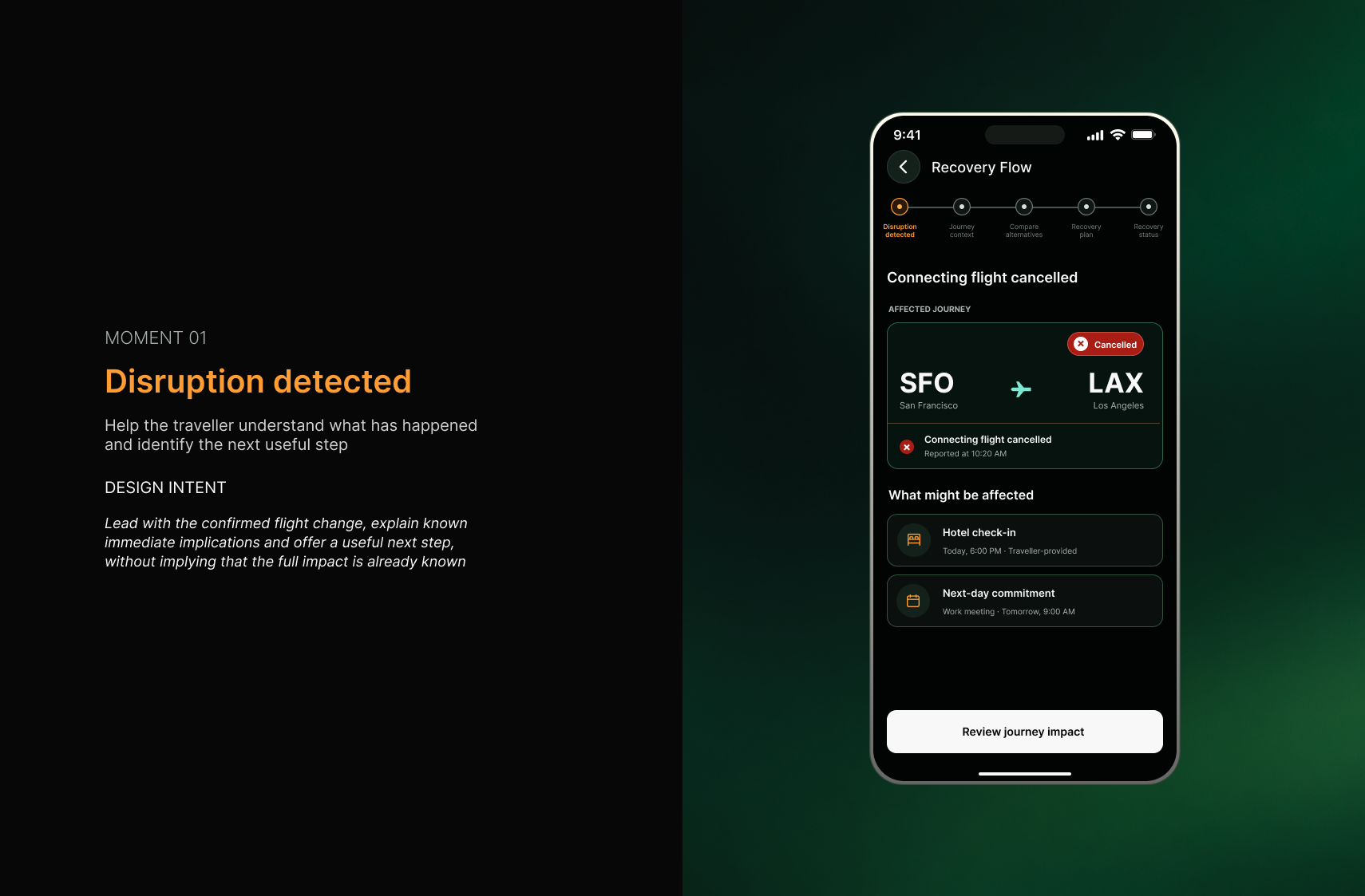
Help travellers distinguish confirmed changes, potential consequences and information that still needs checking.
 Divya Ray
Waypoint explores how an AI agent can recover a disrupted trip by connecting the traveller's plans, comparing viable alternatives and preparing the next steps for approval.
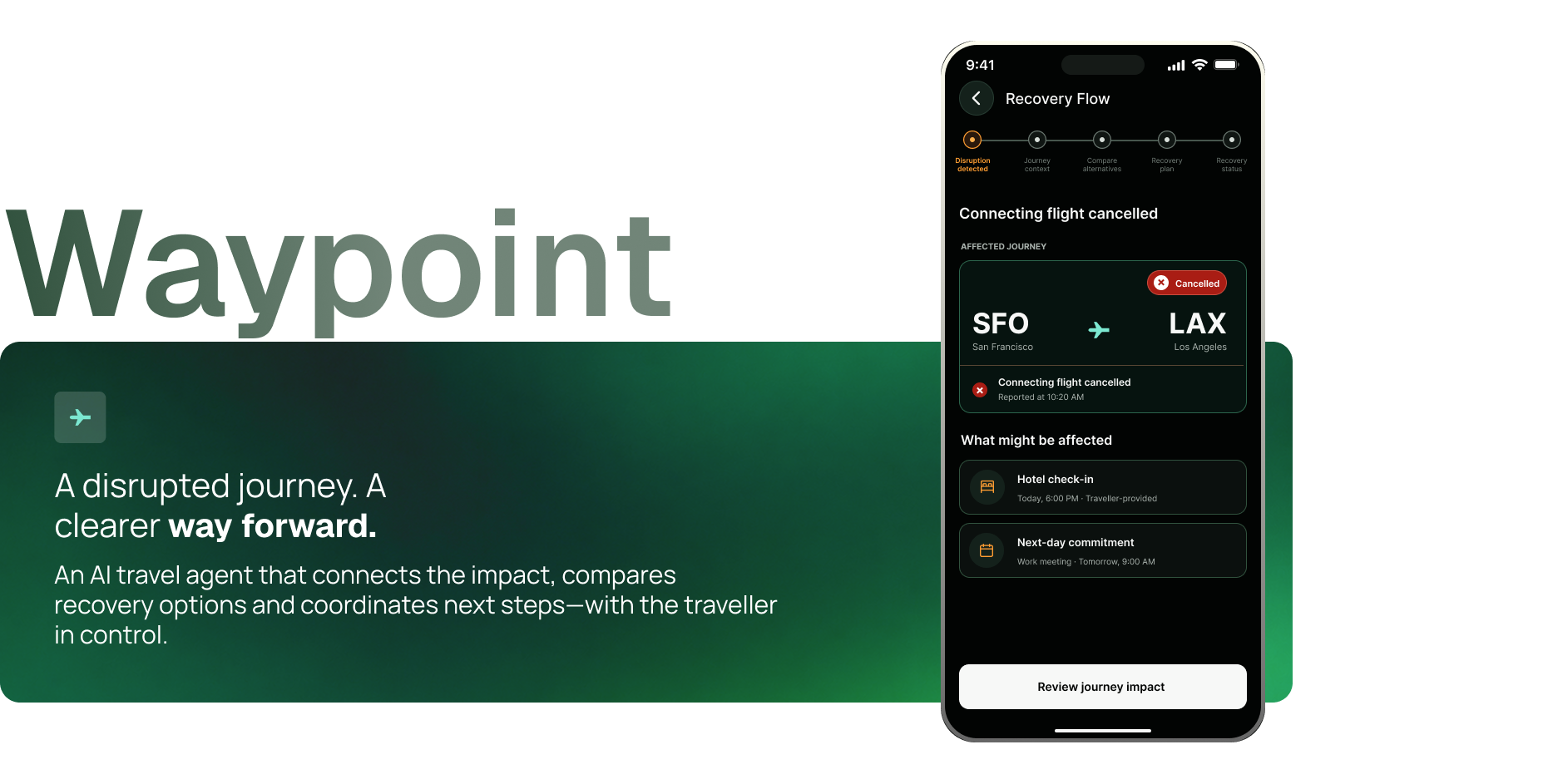
A flight cancellation can disrupt far more than a traveller’s arrival time. It can affect connecting flights, hotel check-ins, onward bookings, prepaid activities and travel budgets.
While an airline may offer an alternative flight, the traveller may still need to figure out what that change means for the rest of their journey. Which bookings are affected? Is the alternative worth taking? Who needs to be contacted? What happens to the money already spent?
Each question creates another decision to make, often using information spread across multiple services and under time pressure.
The challenge isn't simply finding another flight. It's understanding the consequences of the disruption and working out how to recover the journey.
This frames the problem Waypoint will explore: helping travellers move from a disruption notification to a clear, actionable recovery plan.
The aim is not to automate every aspect of travel. It is to investigate where coordinated AI assistance could reduce the effort of recovery while keeping travellers informed and in control.
The potential friction lies in connecting the stages: understanding what changed, determining what else may be affected, choosing an appropriate alternative and following through on the required actions.
This suggests an opportunity to help travellers move beyond an individual flight transaction towards a more coordinated recovery process.
Five stages that may shape a traveller’s recovery after a cancellation.
The potential opportunity is not simply to help a traveller find another flight. It is to investigate whether a more coordinated experience can help them understand the wider impact of disruption, compare viable options and organise the next steps.
When a flight disruption changes a traveller’s plans, they may struggle to understand the wider impact, evaluate recovery options and coordinate the necessary actions across providers.
Travellers need a clearer way to determine which recovery option makes sense for their circumstances, what remains uncertain and what they should do next.
For the initial concept, I focused on travellers whose flight disruptions may affect other parts of their journey.
Primary user hypothesisTravellers facing cancellations or missed connections with time-sensitive onward travel or other commitments.
Help travellers distinguish confirmed changes, potential consequences and information that still needs checking.
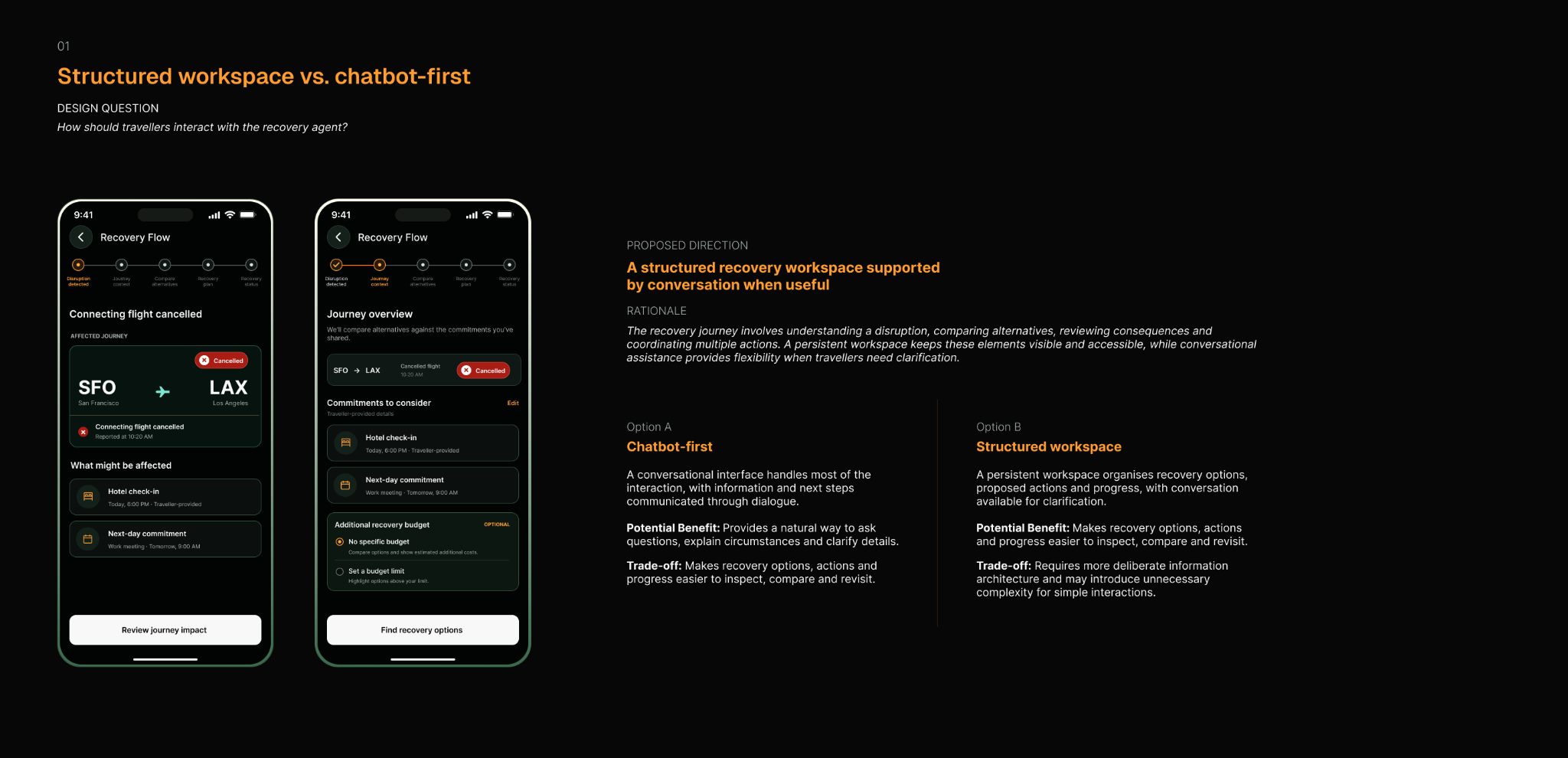
Make relevant trade-offs visible so travellers can compare alternatives against their circumstances.
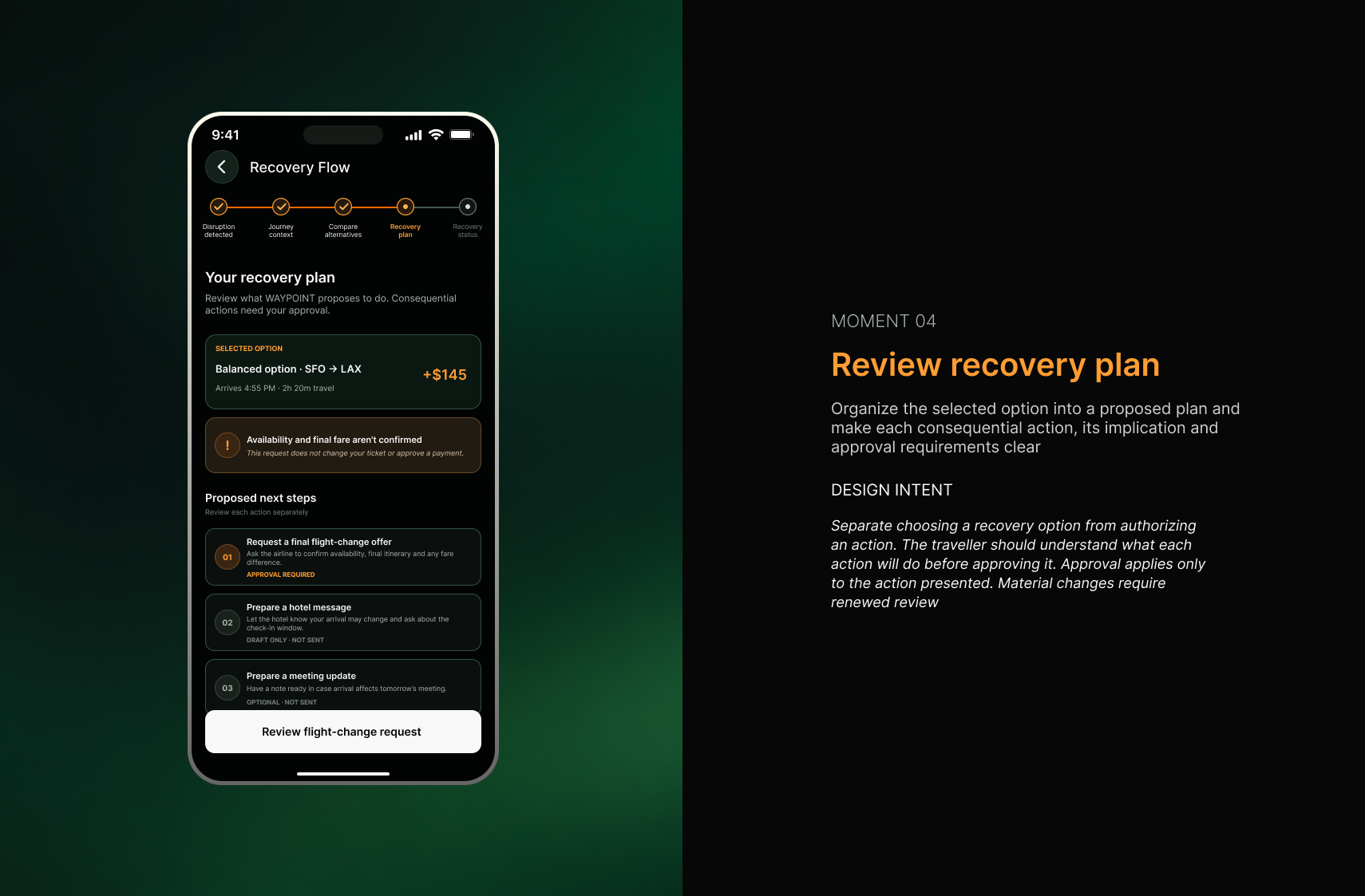
Organise actions into a recovery plan, prepare supported actions and make progress easier to track.
Waypoint is a bounded, human-in-the-loop AI flight-recovery agent. It investigates available information, identifies potential impacts, compares recovery options and prepares a coordinated plan.
It acts only within its permissions and the capabilities of connected systems. The traveller remains responsible for consequential decisions.
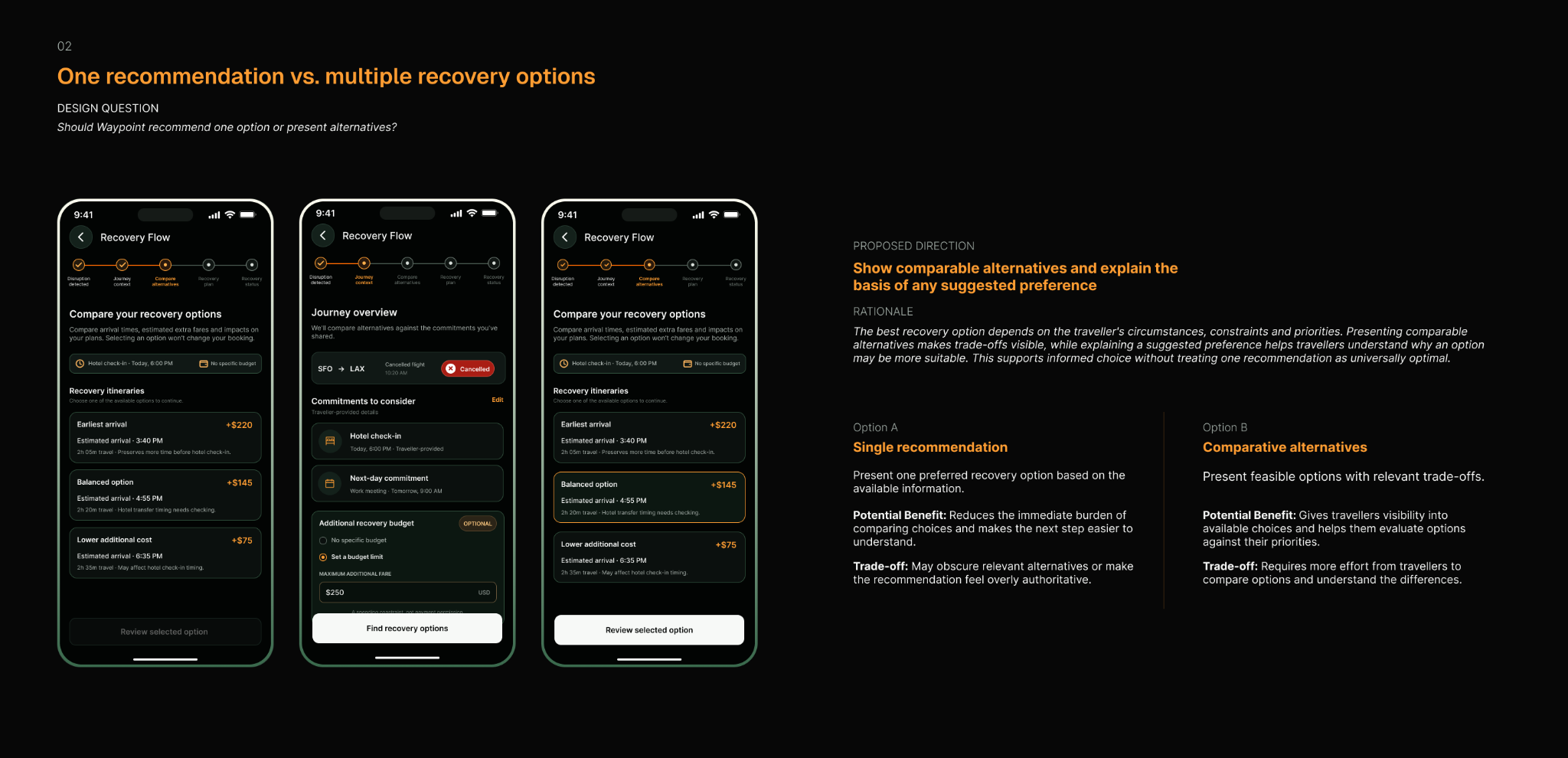
Waypoint explains what has changed and separates confirmed information from potential consequences.
INTENDED OUTCOMEClarity on the immediate situation.
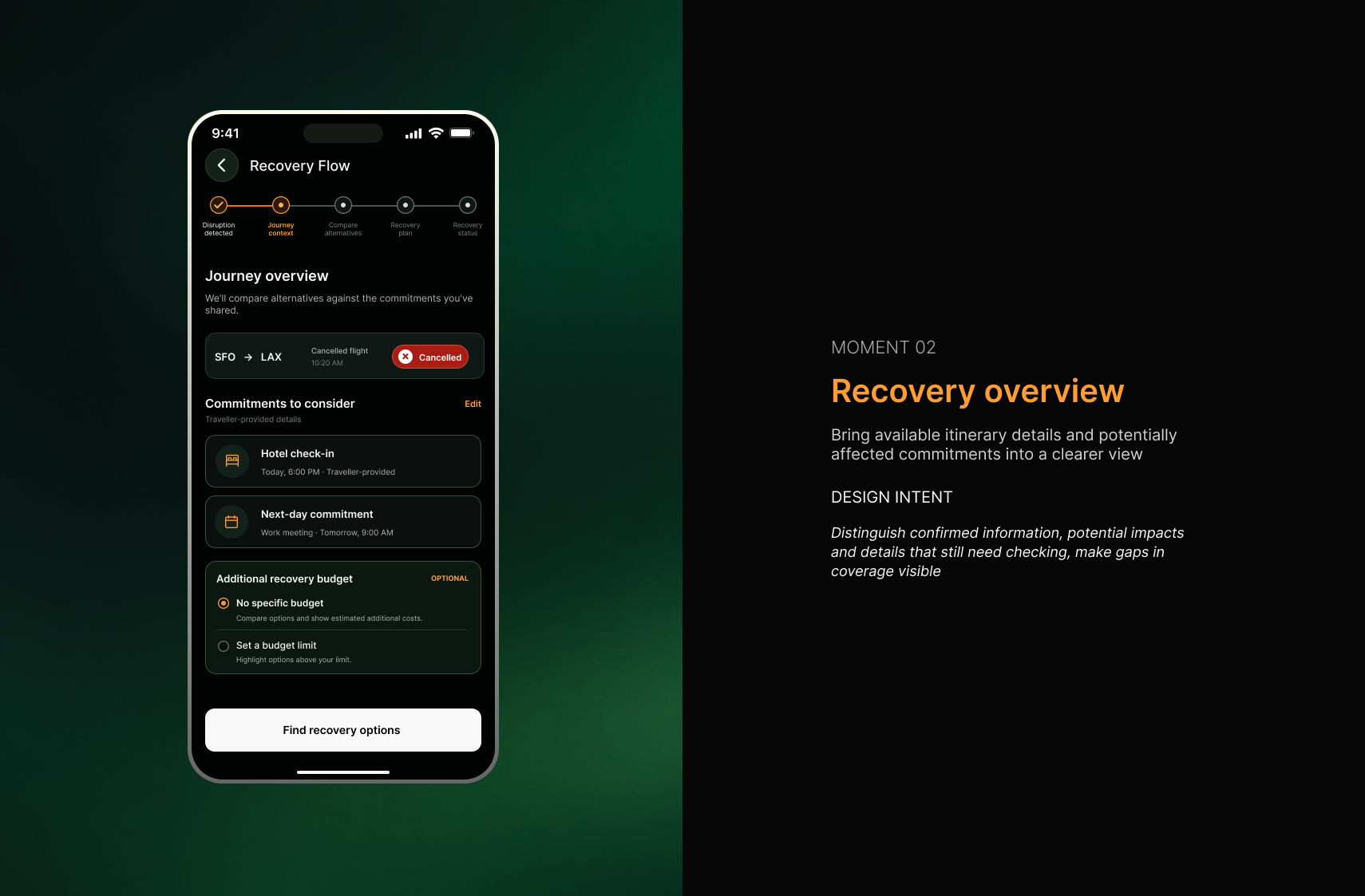
The agent checks available itinerary details and identifies potentially affected commitments, where integrations and permissions allow.
INTENDED OUTCOMEA clearer view of what needs attention.
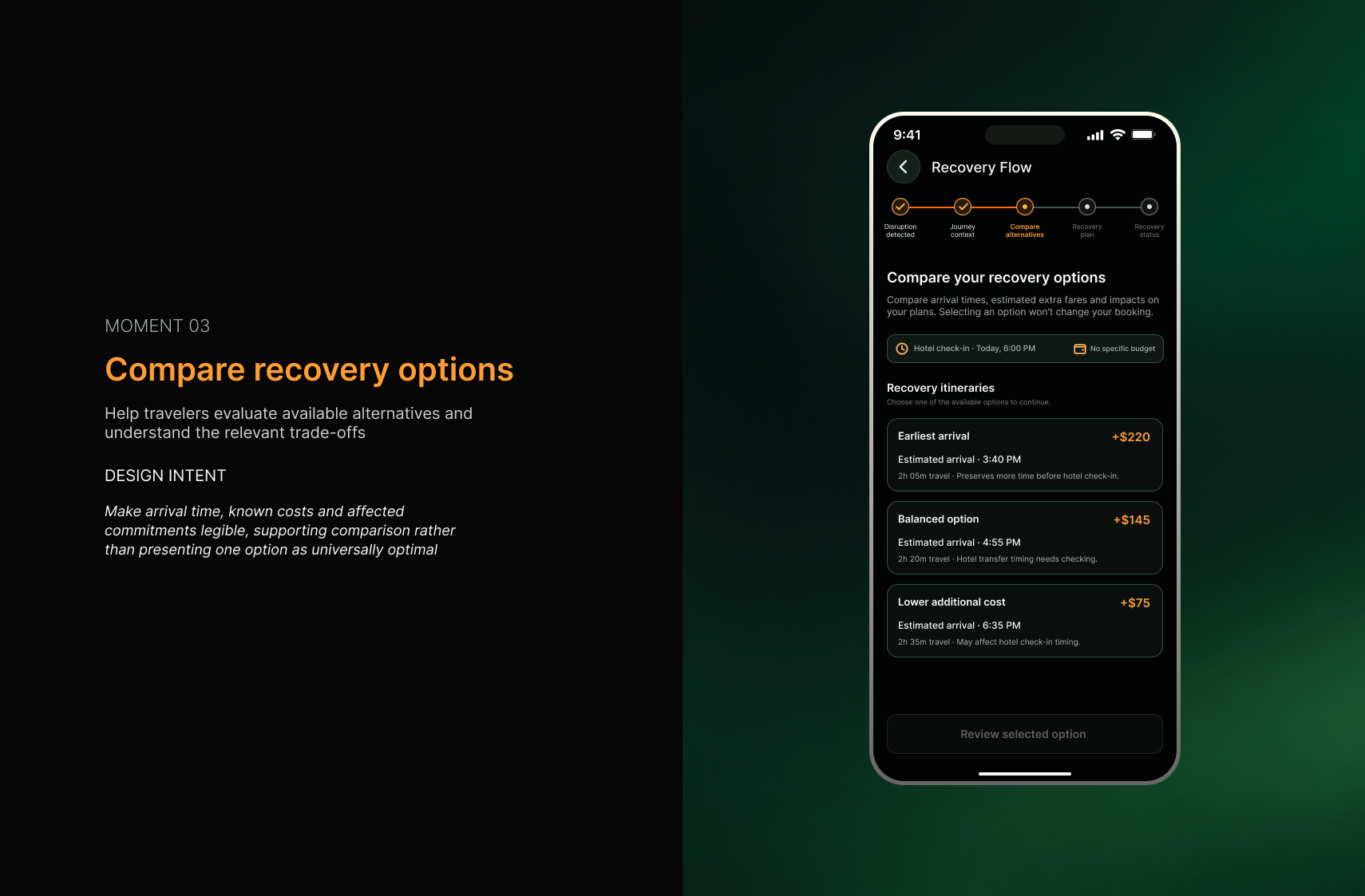
Waypoint compares feasible alternatives using arrival time, known costs and affected commitments.
INTENDED OUTCOMEBetter-informed choices and visible trade-offs.
The agent organises next steps and prepares actions that supported integrations make possible.
INTENDED OUTCOMEA clear plan rather than disconnected tasks.
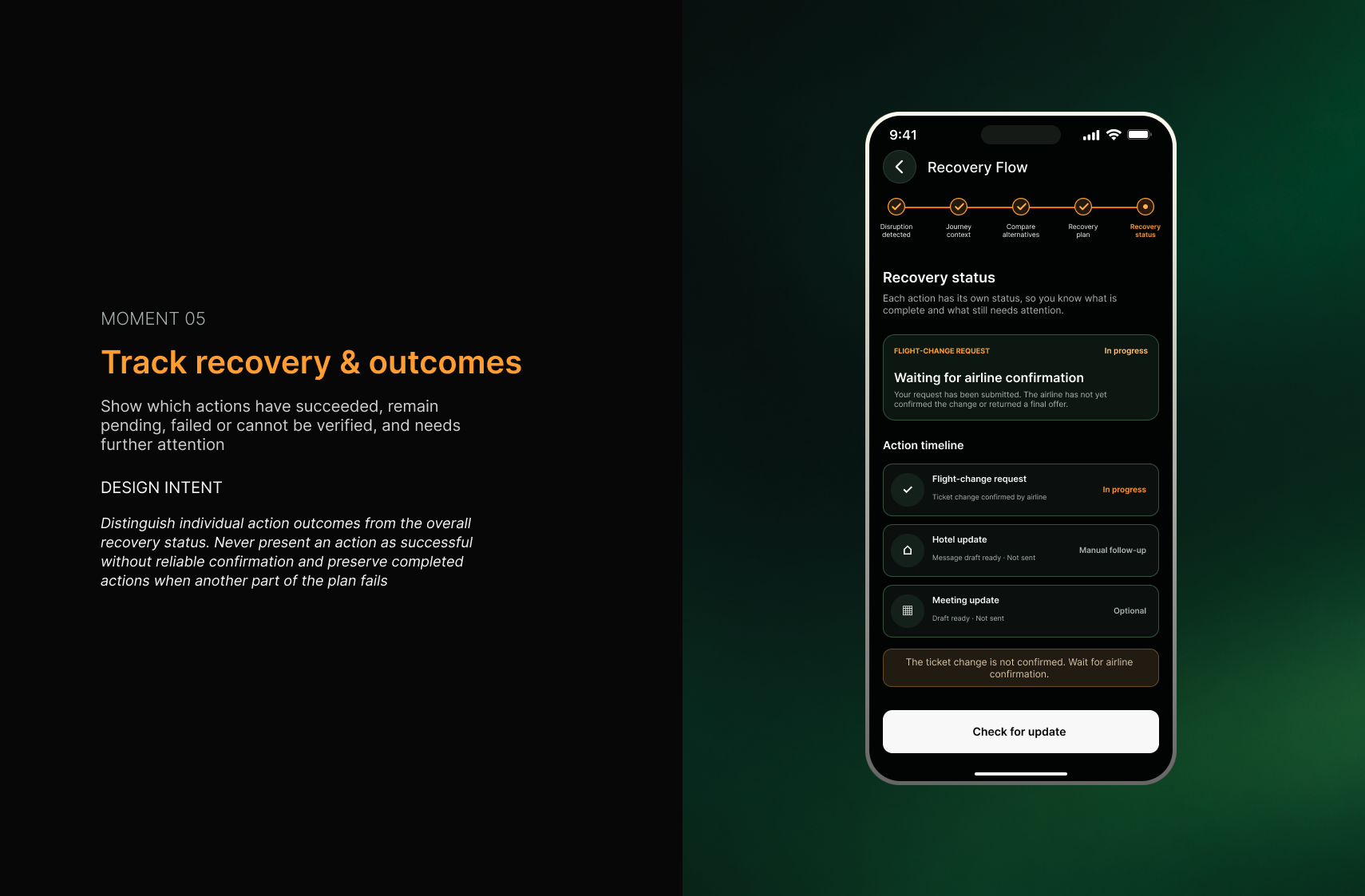
The traveller approves consequential actions. Waypoint tracks status and confirms outcomes where reliable confirmation is available.
INTENDED OUTCOMEGreater visibility and control.
Waypoint is designed to help travellers investigate, compare and coordinate recovery—not to make every decision on their behalf.
The agent can organise available information and prepare supported actions within its permissions. Consequential decisions remain with the traveller, and action outcomes must be verified wherever reliable confirmation is available.
Understand available information and potential impacts.
Organise options and proposed next steps.
Seek approval for consequential actions and verify outcomes.
Before settling on the experience direction, I used desk research and exploratory questions to examine how existing travel products address disruption notifications, alternative-flight discovery and recovery assistance—and where further investigation might be valuable.
My starting hypothesis was that a flight cancellation can create a wider journey-recovery problem. I treated this as a hypothesis to examine, rather than assuming that coordination was necessarily the biggest problem or that AI was the right solution.
What do existing travel products offer for disruption notifications, alternative flights and recovery assistance?
Where might travellers still need to coordinate information, decisions and actions across different providers?
Could AI assistance provide meaningful value beyond existing notifications, checklists or decision-support tools?
Communicating cancellations, delays and changes to flight status.
Does the available information help travellers understand the implications for the rest of their journey?
Finding or comparing replacement flight options.
How much of the wider recovery decision must the traveller work through separately?
Explaining available assistance, rebooking options and applicable policies.
How easily can travellers understand what applies to their specific circumstances?
Managing bookings and contacting airlines or other travel providers separately.
What effort might be involved in coordinating information and actions across multiple channels?
Travel products and providers address parts of the disruption and recovery process, including flight-status communication, alternative-flight discovery, assistance policies and booking support.
Travellers may find it difficult to connect changes to a flight with other journey commitments.
Bringing relevant information, options and next steps together may reduce the effort required to organise recovery.
A checklist, structured decision-support experience or simpler workflow could potentially address the problem without agentic automation.
The exploration points to a question worth investigating: whether Waypoint can provide value by helping travellers coordinate the wider recovery process, rather than duplicating flight alerts or search.
Waypoint is designed as a bounded AI agent that investigates available information, evaluates recovery options and prepares coordinated next steps.
Its role is not to make every decision autonomously. The agent operates within available information, system capabilities and explicit permissions, while the traveller retains control over consequential decisions.
Retrieve permitted information, identify potential impacts and explore available alternatives.
Example: Check accessible flight alternatives.
Compare options, build a recovery plan and prepare supported actions or provider messages.
Example: Prepare a proposed recovery plan for review.
Perform supported consequential actions only within the applicable permissions and approval requirements.
Example: Confirm a booking change where the integration and authorisation permit it.
The outcome may be Succeeded, Pending, Failed or Unverified. The traveller may also decline a proposed action before execution.
The key distinction: Approval means the action has been authorised; it does not mean the action has succeeded.
When an option or material plan detail changes, dependent actions must be reassessed and approval renewed where necessary. Retries must not duplicate actions already confirmed as successful.
Response: Identify what is unavailable and ask the traveller for missing details when necessary.
Response: Explain the limitation and present next available options or manual steps where possible.
Response: Show the failure, explain what remains unresolved where known, and provide a supported next step.
Response: The traveller has authorised the proposed action, but the provider rejects the request or cannot complete it. Report the outcome, preserve the action's status and explain the supported next step. Do not represent the action as successful.
Response: The traveller chooses not to authorise the proposed action. Do not execute it. Preserve the decision and reassess any dependent steps if the recovery plan needs to change.
Response: Communicate that the outcome is not yet confirmed. Preserve the action's current state and avoid claiming success or retrying blindly when the original outcome is still unknown.
These are different states: A provider rejection occurs after an action is authorised, whereas a traveller decline means the action was not authorised.
Use available information and identify important gaps before proposing recovery options.
Explain the basis of recommendations and distinguish facts from assumptions.
Keep actions within explicit permissions and preserve traveller approval for consequential decisions.
Distinguish proposed, approved, in-progress, completed, failed and unresolved actions where the underlying system can support those states.
Designing an AI flight-recovery experience involves more than deciding what the agent can do. It requires choices about how travellers understand their options, how much control they retain, and how the system communicates uncertainty.
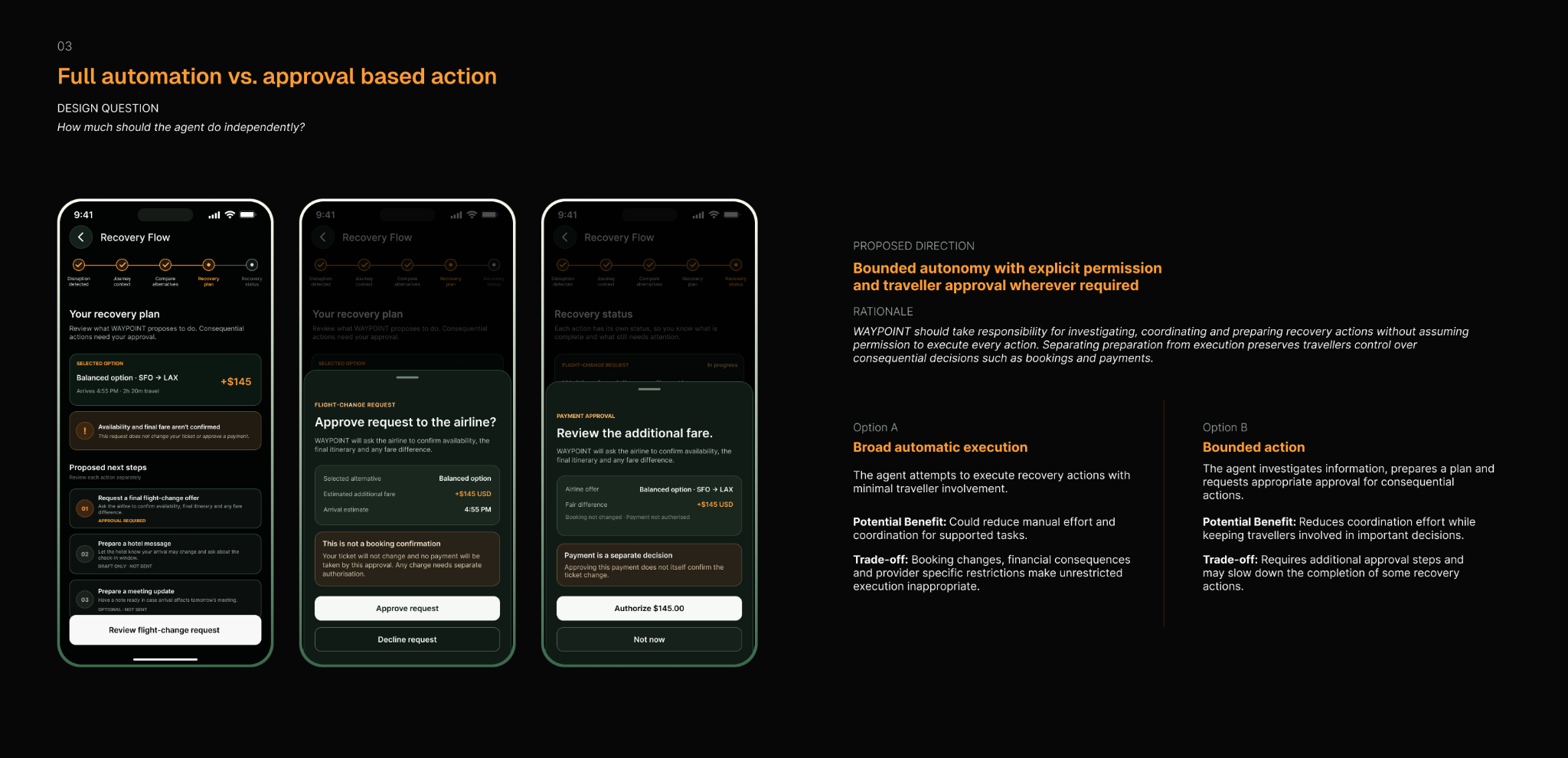
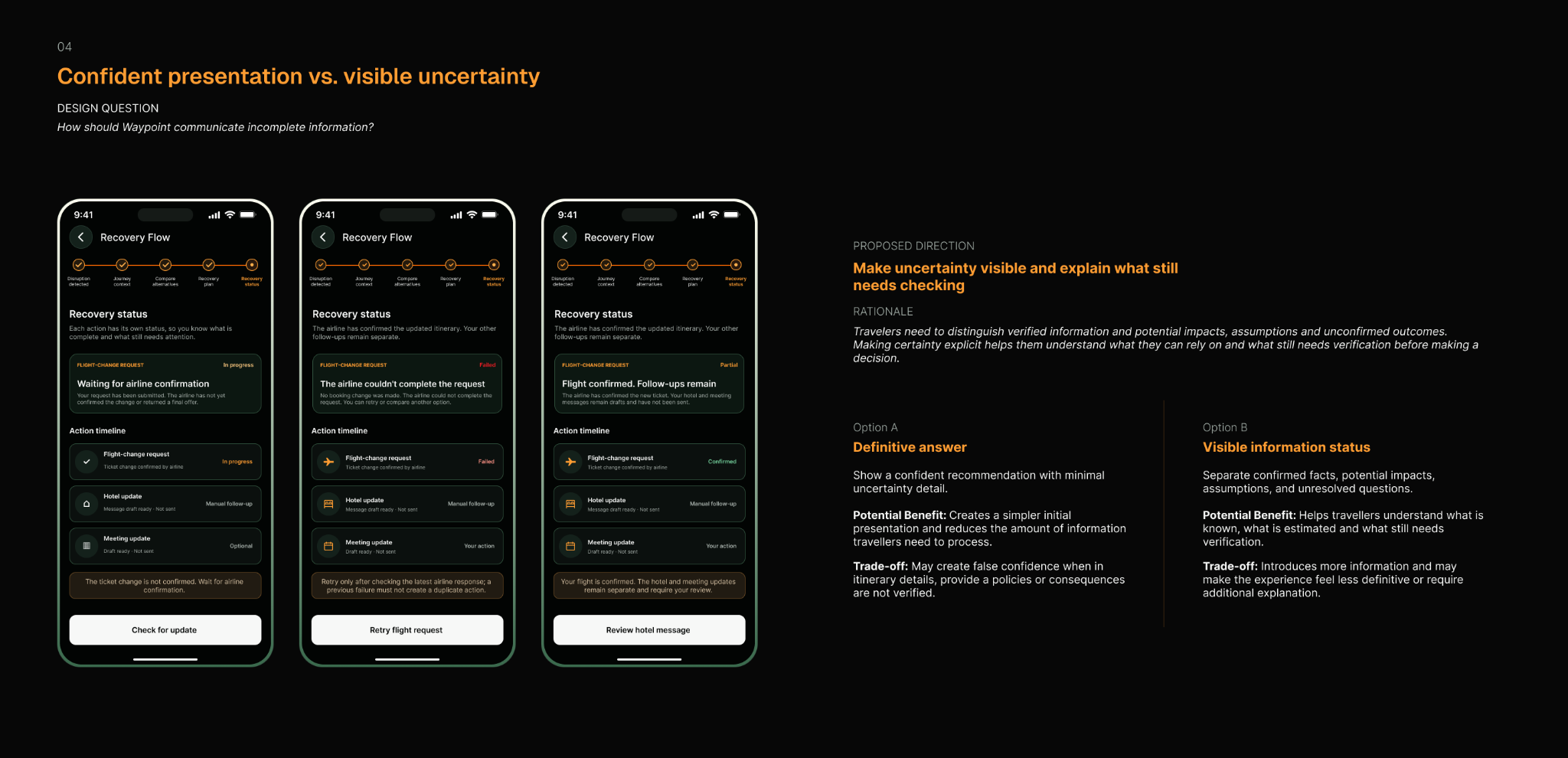
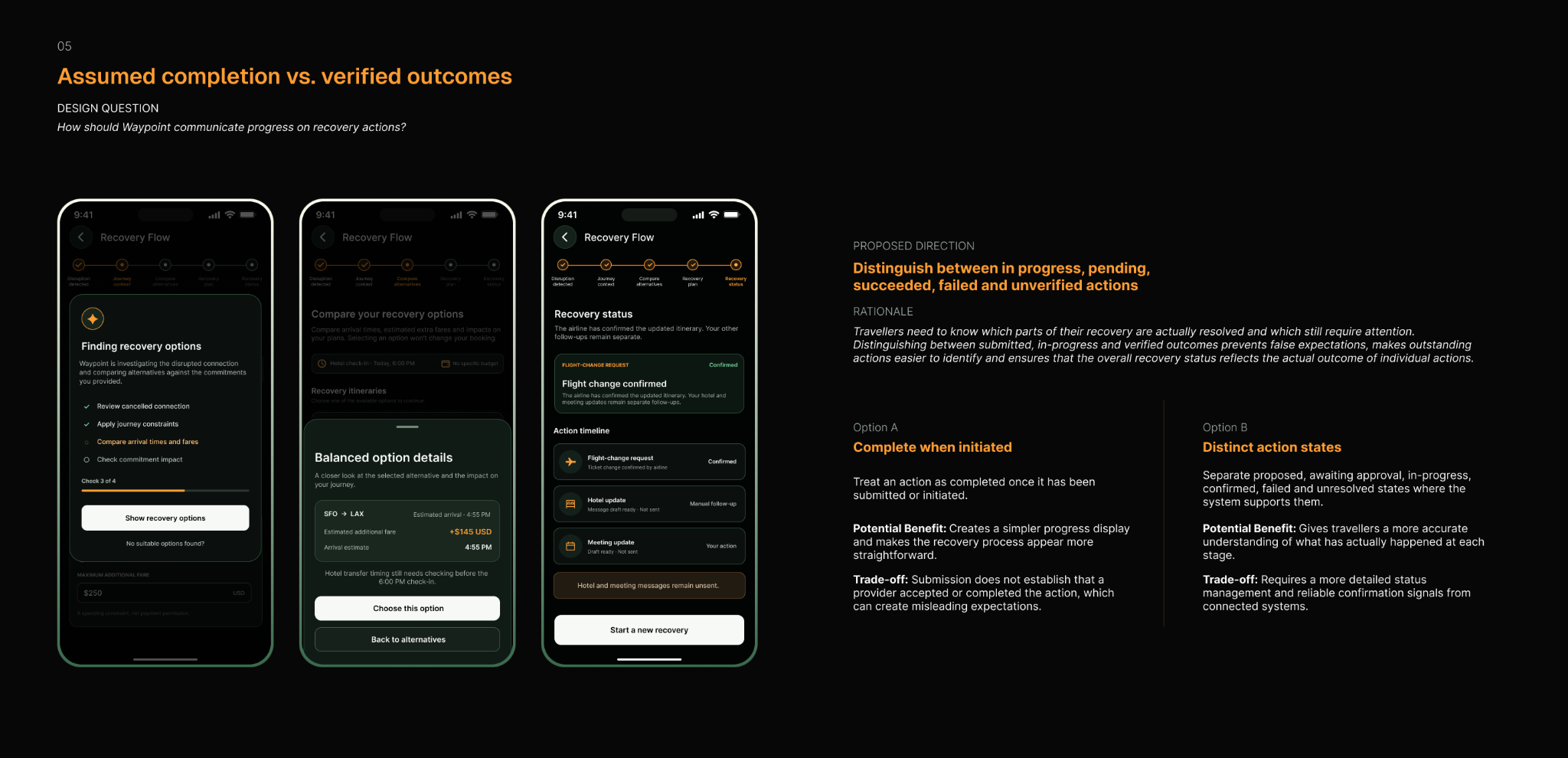
Automate the coordination. Preserve the decision. Verify the outcome.
Waypoint should reduce the work involved in understanding and coordinating recovery while keeping consequential decisions transparent, controlled and verifiable.
Waypoint is currently a proposed experience informed by desk research and design exploration. Primary research and usability testing have not yet been conducted.
Understand whether flight disruption creates a wider recovery problem for the target travellers.
Interview travellers who have experienced cancellations or missed connections, focusing on a recent real-world incident.
Understand the problem's significance, when it occurs and which recovery tasks cause the greatest difficulty.
Determine whether the proposed Waypoint experience adds value over simpler approaches.
Test comparable concepts with representative travellers.
Compare usefulness, comprehension, effort, trust and appropriate delegation—without assuming the agent will perform best.
Determine whether the experience is understandable and its essential dependencies are achievable.
Test key interactions and review technical and operational dependencies with relevant stakeholders.
Identify usability issues, capability gaps, integration dependencies and safeguards needed before implementation.
DependencyAccess to sufficiently reliable disruption updates and alternative-flight information.
QuestionCan the experience distinguish current, confirmed information from estimates or outdated data?
DependencyAppropriate access to relevant itinerary details and other journey commitments.
QuestionWhat information can the agent access, under what permissions, and what happens when information is unavailable?
DependencySupported mechanisms for preparing or carrying out relevant recovery actions.
QuestionWhich actions can actually be performed, and which must remain manual steps for the traveller?
DependencyReliable signals to determine whether provider actions succeeded, failed or remain unresolved.
QuestionHow will Waypoint avoid presenting an attempted action as a completed outcome?
Does research establish a meaningful recovery challenge for a clearly identified group of travellers?
Does the agent provide meaningful advantages over a checklist or structured decision-support experience?
Can essential information, permissions, actions and confirmations be supported with appropriate safeguards?
Waypoint began with a question: how might we help travellers recover their plans, rather than simply find another flight?
That question shaped an exploration of the wider recovery process—from understanding a disruption and evaluating alternatives to organising next steps and verifying outcomes.
The proposed direction is a bounded, human-in-the-loop AI agent that helps coordinate recovery while keeping consequential decisions with the traveller.
Explore the coordination of journey recovery rather than simply duplicating flight alerts or flight search.
Investigate how an agent could gather information, evaluate options, prepare actions and track progress within explicit permissions.
Keep trade-offs visible, communicate uncertainty, preserve traveller approval for consequential actions and distinguish confirmed outcomes from unresolved ones.
Waypoint explores a future where a disrupted journey doesn't leave the traveller to coordinate every consequence alone.
The goal is not maximum automation. It is helping people understand their options, make informed decisions and move forward with greater clarity and control.