01
Initiate and manage
Purchase requests, vendor onboarding, and procurement workflows.
- Purchase requisition creation
- Vendor onboarding
 Divya Ray
ENTERPRISE AI · FINANCE TRANSFORMATION · PR CREATION
Making Finance Conversational
Exploring how conversational AI can connect finance workflows, surface relevant business context, and help people move from requests to decisions across the enterprise.

THE CHALLENGE
Finance workflows often involve multiple steps, disconnected information, and coordination across people and systems. Finding the right information is only part of the problem—users also need to understand relevant context, complete structured transactions, and move decisions forward without losing visibility or control.
MULTI-CLIENT POC
Across financial services and enterprise finance, teams navigate procurement, accounting, payments, reconciliation, and reporting. This proof of concept explored where conversational AI could make these processes easier to access, understand, and act on.
THE BIGGER PICTURE
The opportunity spans more than procurement: initiate work, resolve exceptions, and understand financial status through a more accessible conversational layer.
Purchase requests, vendor onboarding, and procurement workflows.
Invoice matching, reconciliation, payments, and accounting activities.
Financial status, exceptions, close, reporting, and executive insights.
BUSINESS IMPACT
The potential value of a conversational finance layer extends across initiating work, resolving exceptions and understanding business performance.
01
02
03
04
THE APPROACH
Understand the user's intent, requirements, and relevant purchasing context.
Organise the request, compare relevant options, and help determine suitable next steps.
Help assemble a structured requisition and initiate approval while keeping people in control.
THE OPPORTUNITY
The challenge is not simply filling out a form. Employees may need to evaluate multiple products, compare catalogue and vendor options, specify sizes and quantities, assign cost centres, and confirm delivery details. How might conversational AI guide these decisions without overwhelming the user—and still keep users and approvers in control?
THE DETAILED WORKFLOW · VENTIA PR CREATION
The Ventia walkthrough follows a user assembling a multi-item safety-equipment request. The assistant guides catalogue discovery, captures purchasing context, consolidates the request for review, and supports an approval handoff through Microsoft Teams.
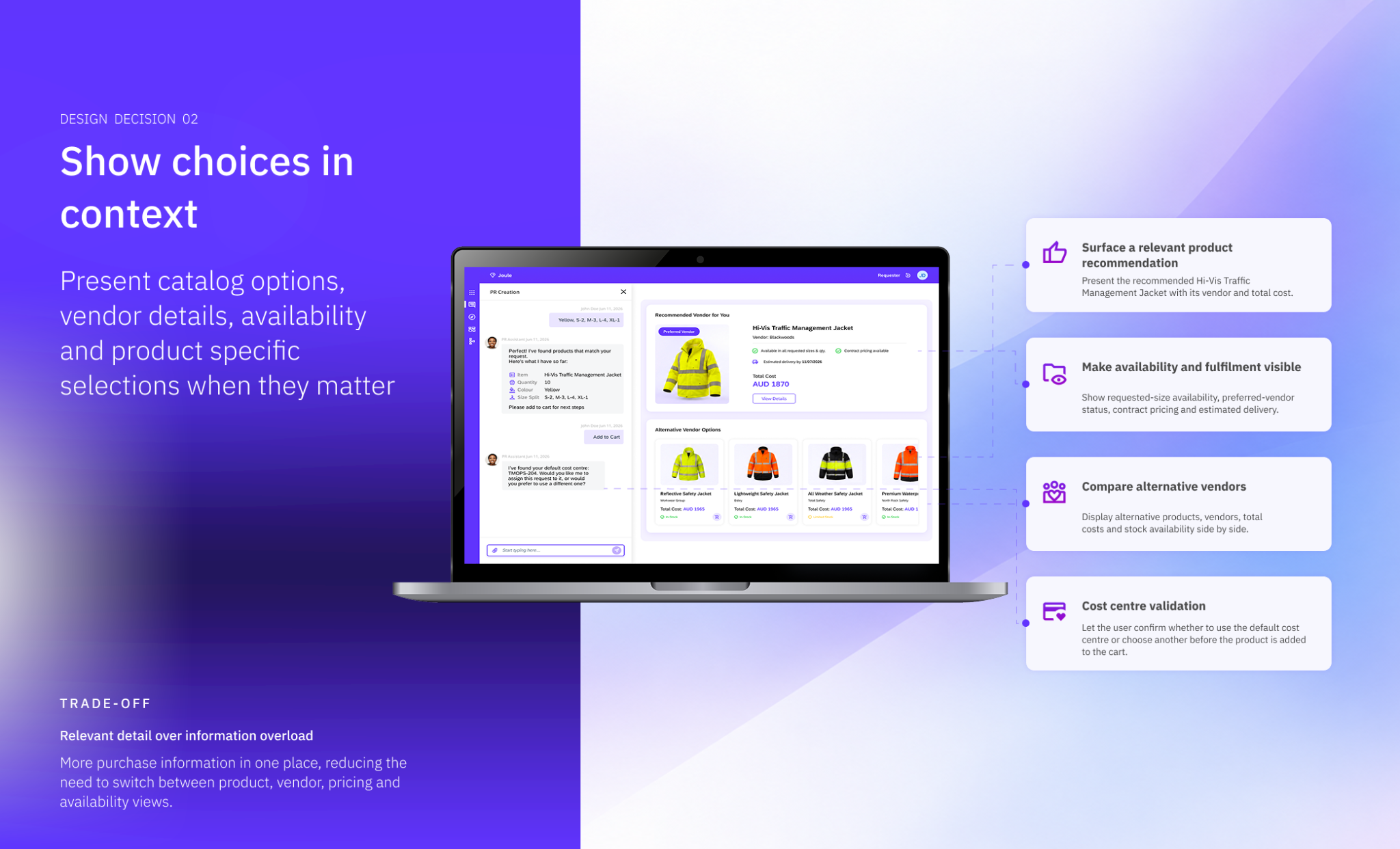
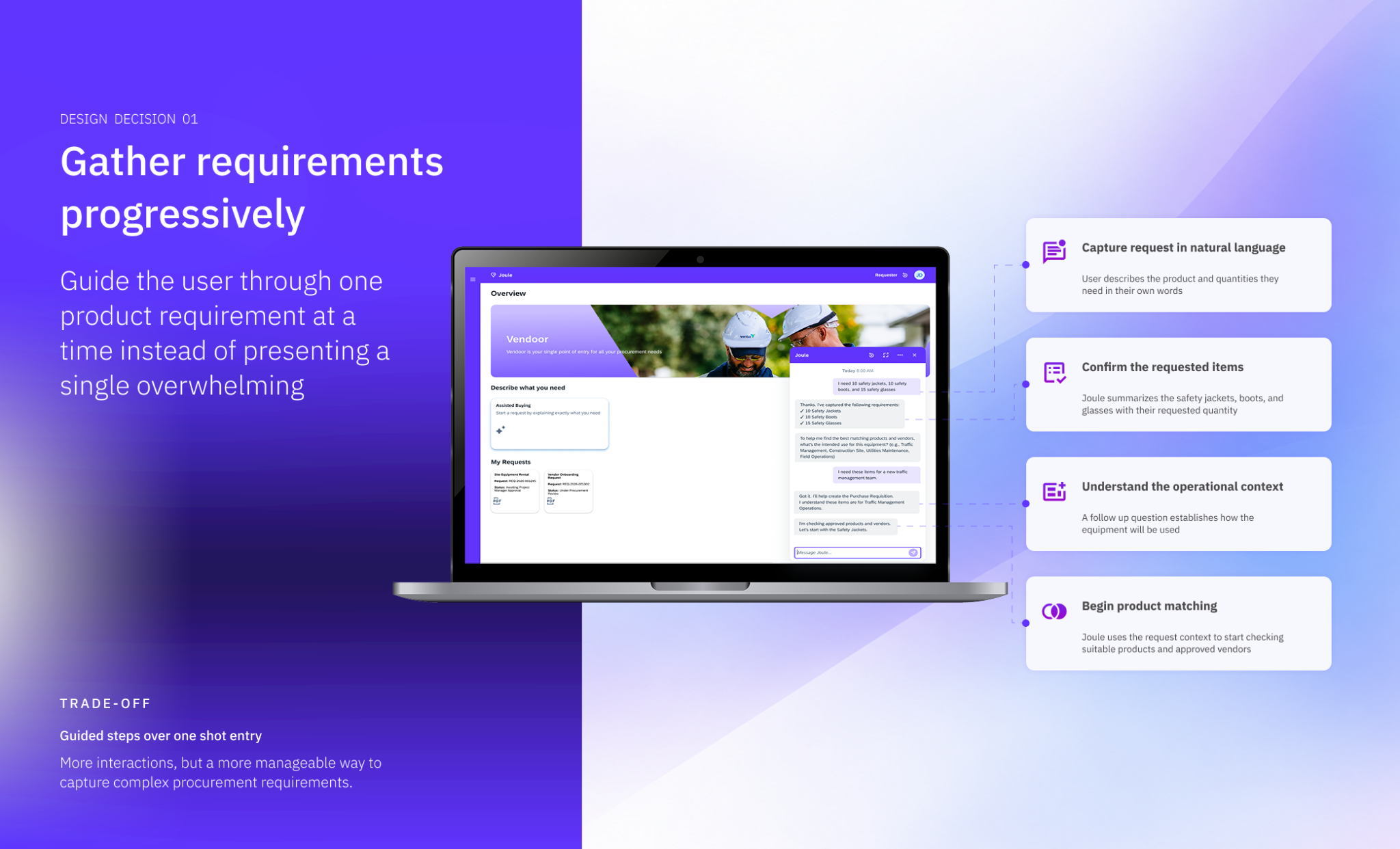
The user asks for 10 safety jackets, 10 safety boots, and 15 pairs of safety glasses for a traffic management team.
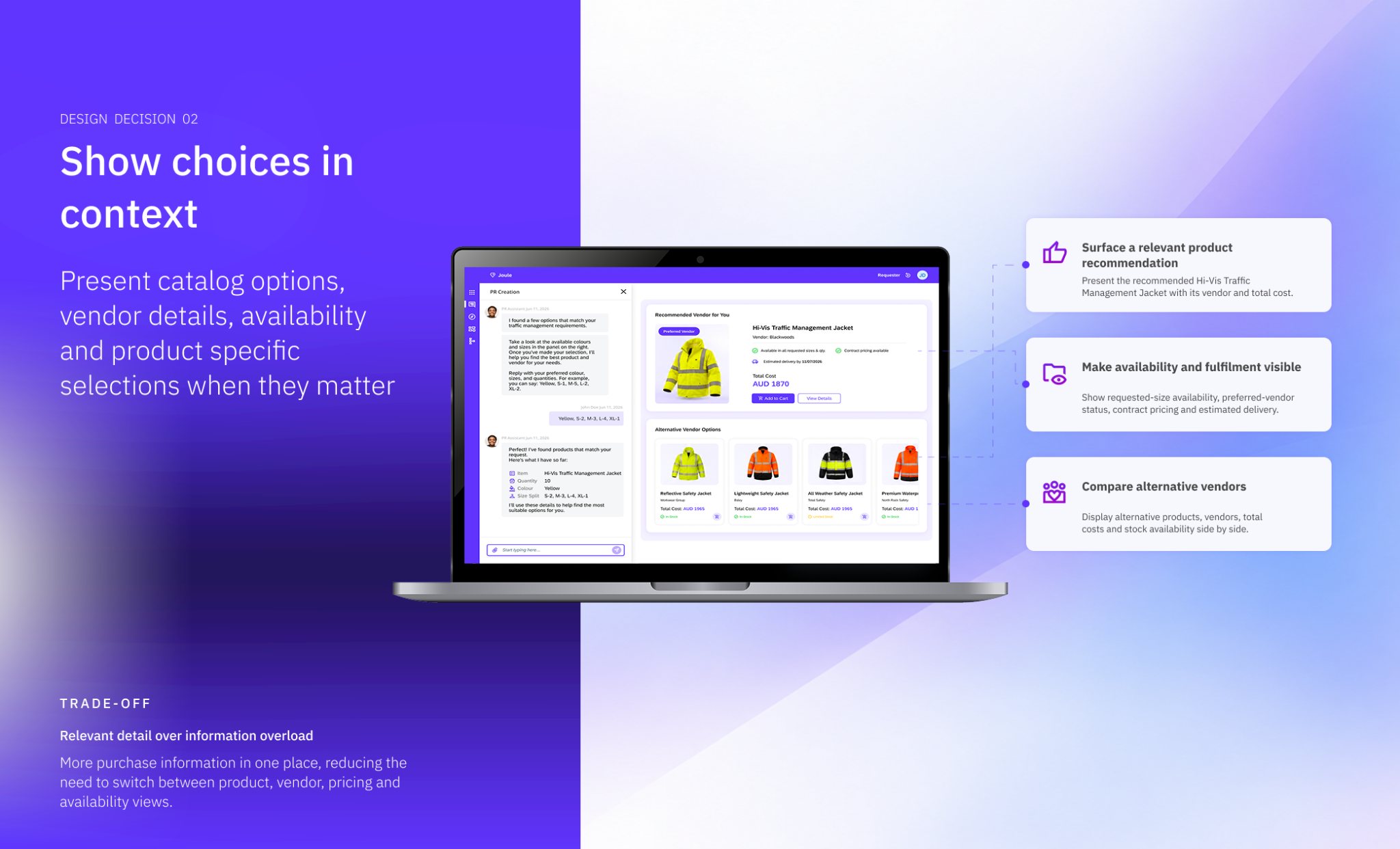
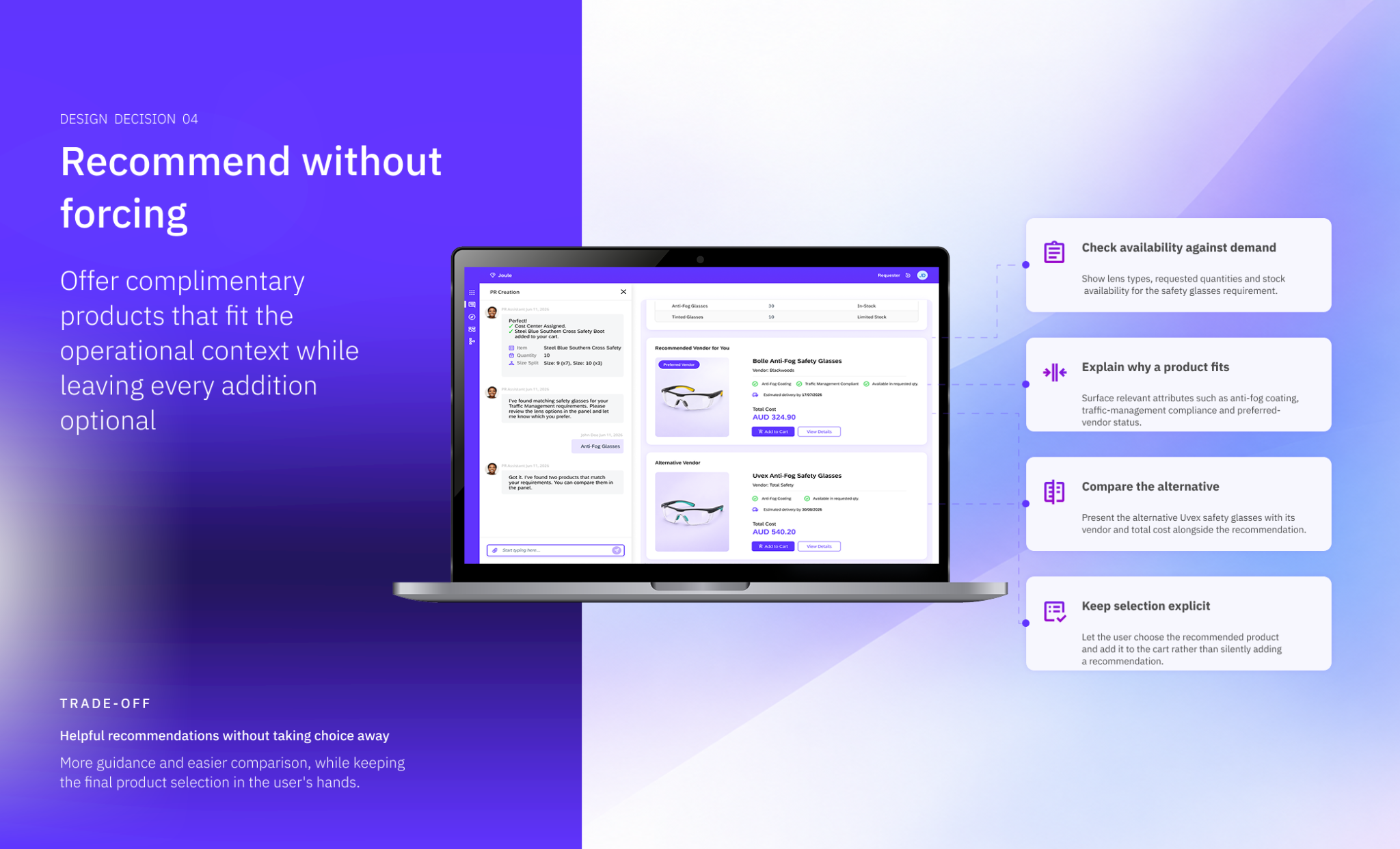
The assistant works through products one at a time, presenting relevant catalogue and vendor options for the user to review.
Capture the remaining information needed to assemble the request, alongside the selected products.
After the requested items are addressed, the assistant can surface relevant optional products such as a hard hat, safety torch, or protective work gloves.
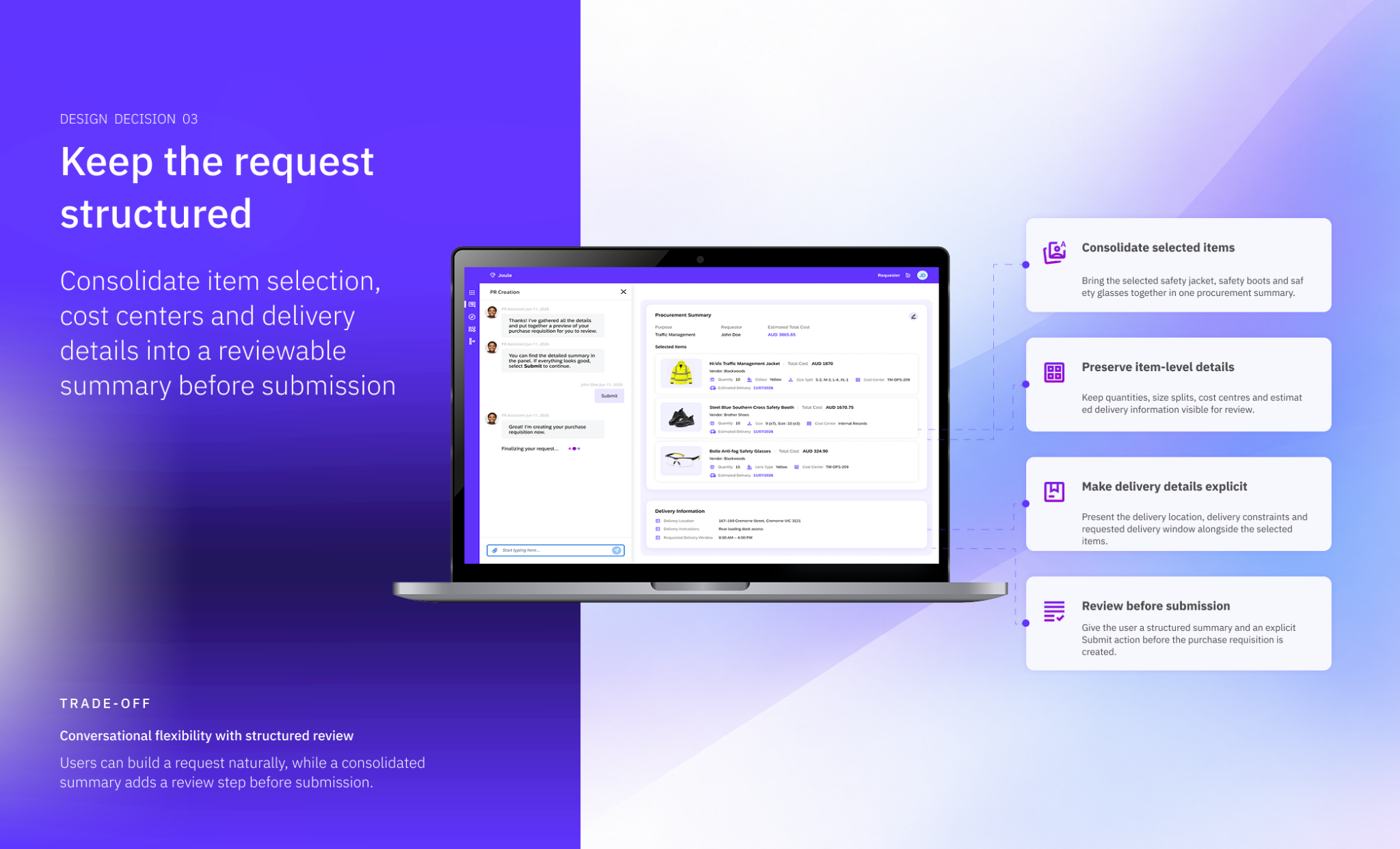
Bring the selected products and request context into one structured summary for the user to review before submission.
After the user submits, the assistant confirms that the purchase requisition has been created and sent to the designated approver.
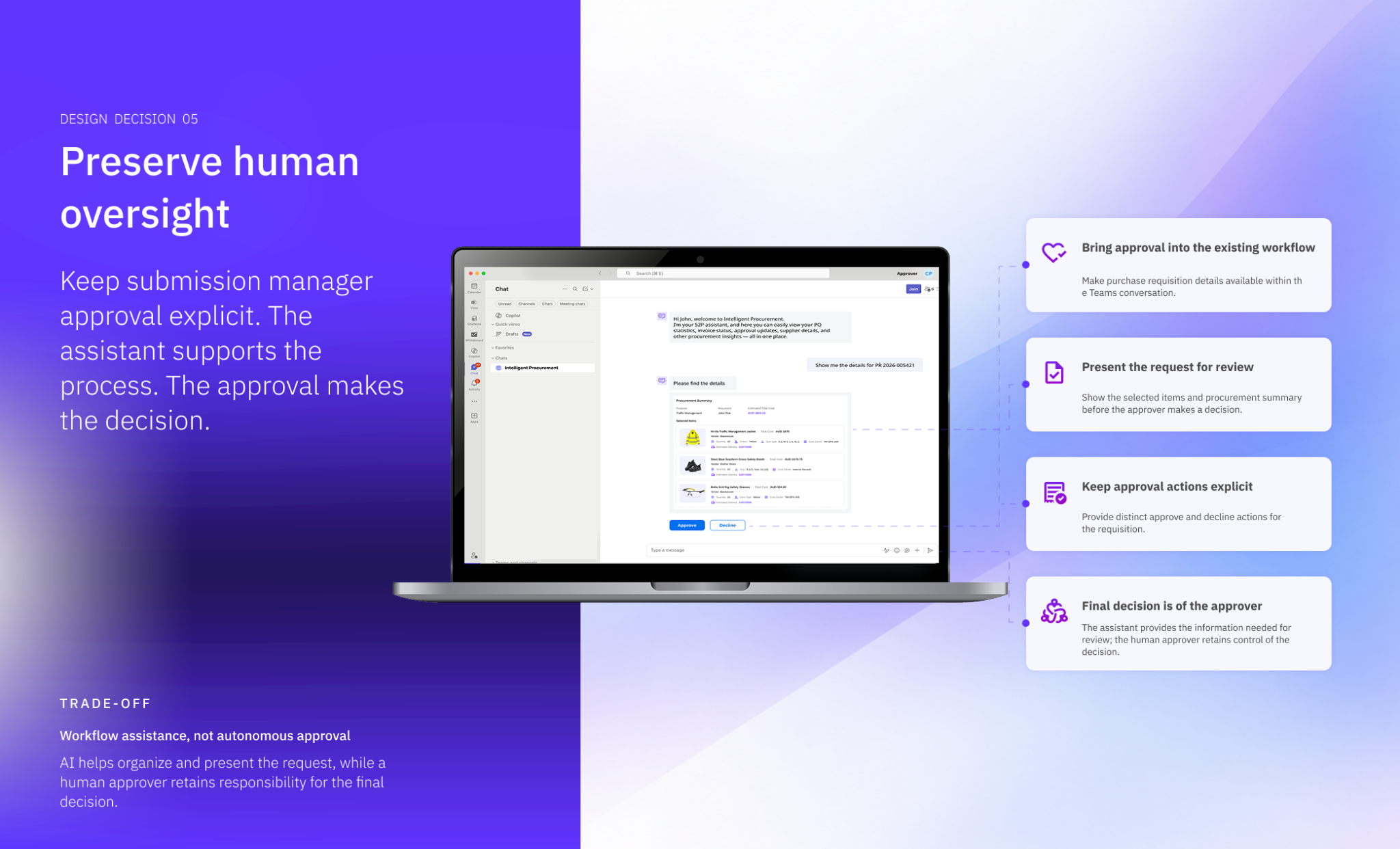
The manager reviews the procurement summary in the demonstrated Microsoft Teams approval experience and chooses to approve or decline.
CROSS-PRODUCT COLLABORATION
The experience brings together conversational access through SAP Joule, finance-focused assistance through IBM Ask Finance, and manager-facing collaboration through Microsoft Teams.
Conversational access to relevant SAP business capabilities.
CONVERSATIONAL ENTRYFinance-focused assistance, contextual information, and the associated workflow experience.
FINANCE ASSISTANCEManager-facing approval interaction and relevant notifications.
COLLABORATION & ACTIONKEY DESIGN DECISIONS
FINAL DESIGN
REFLECTION
Designing conversational enterprise AI is not simply about replacing forms with chat. It is about guiding users through interconnected decisions, bringing business context into the interaction, and translating those decisions into a structured workflow. In procurement, recommendations must be useful without removing user choice—and approval must become easier without removing human accountability.