Increase transparency
Ensure full visibility into dispute status and resolution.

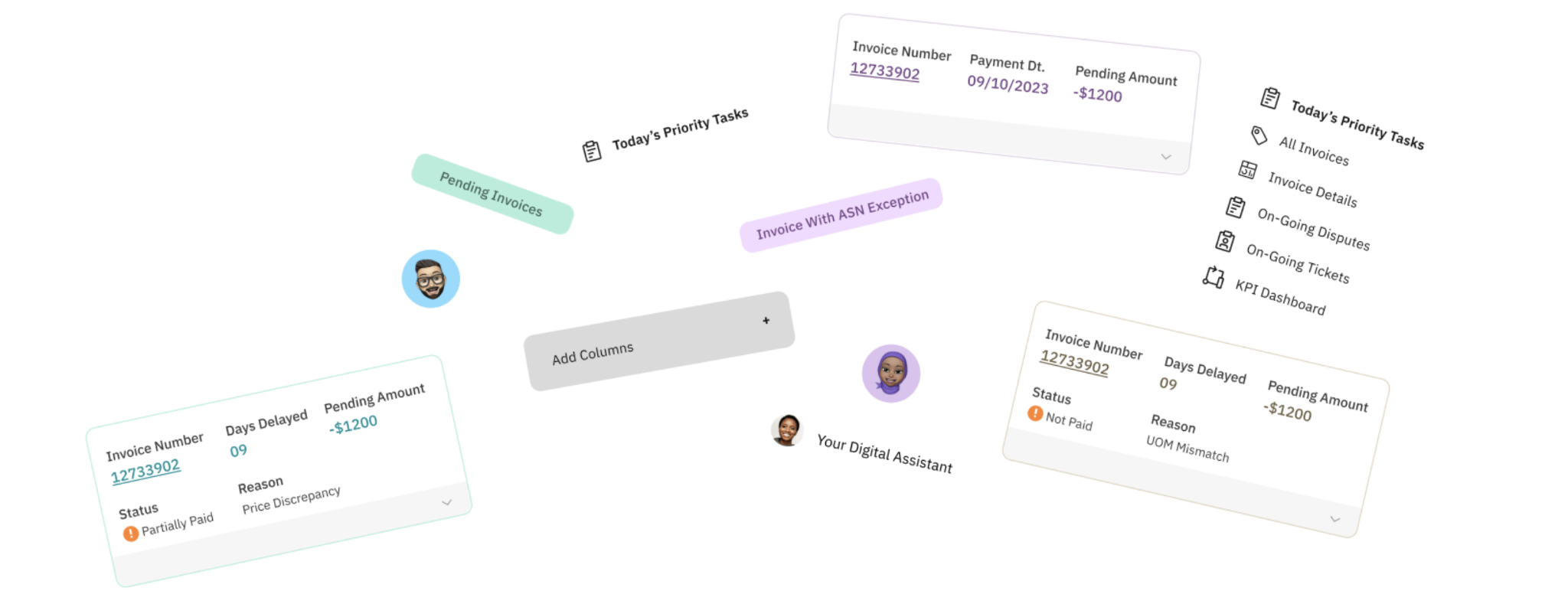
An enterprise dispute resolution experience designed to streamline dispute workflows, improve visibility into discrepancies and help accounts payable teams prioritise and resolve issues more efficiently.
Product Designer
Automated Dispute Resolution Portal
Automation · Supply Chain Visibility
Shipped
A leading Retail Enterprise needed a streamlined solution to automate their Dispute Resolution Process, improve end-to-end visibility, and enhance discrepancy identification for faster, more efficient processing.
The dispute resolution portal is highly manual and fragmented, requiring AP analysts to switch between multiple tools, leading to inefficiencies in tracking and resolving disputes. The absence of structured prioritization makes it challenging to address high-risk discrepancies first, causing financial inconsistencies such as overpayments or underpayments. The process heavily relies on manual intervention, increasing the risk of errors and prolonging resolution times, impacting financial accuracy.
Ensure full visibility into dispute status and resolution.
Improve communication between AP analysts, vendors, and finance teams.
Match role-specific tasks and streamline dispute resolution.
Improve data accuracy and immediate visibility of data.
Untimely Resolution
60–90 days lag in data.
Inaccurate Data
Incorrect PO “Fishing”.
Manual Process
Multiple sources of data and unstructured vendor communications.
Lack of Visibility
Vendor, Carrier and Buyer not on the same page. “Siloed data”.
Our approach focuses on providing a guided experience that adapts to both new and experienced users. The system integrates intelligent automation to anticipate user needs, automate workflows, and transform complex, data-heavy processes into actionable insights, empowering AP analysts to resolve discrepancies/disputes, manage under/over payments efficiently.
40%
Faster dispute resolution with automated workflows.
50%
Reduction in follow-ups through real-time tracking and notifications.
35%
Fewer invoice discrepancies with improved accuracy and validation.
1500+
Vendors onboarded and USD 53B total PO Flow.
USD 120M
Total disputes managed by supplier collaboration portal.
USD 51M
Auto resolved through supplier collaboration portal.
Faster
Resolution
Visibility into 149M in Shortages.
USD 69M
Resolution driven through the portal with Vendors.
20%
Settlement Accuracy
40%
Productivity Increase
Add feature description and supporting content here. This area is reserved for text paired with the image on the left.
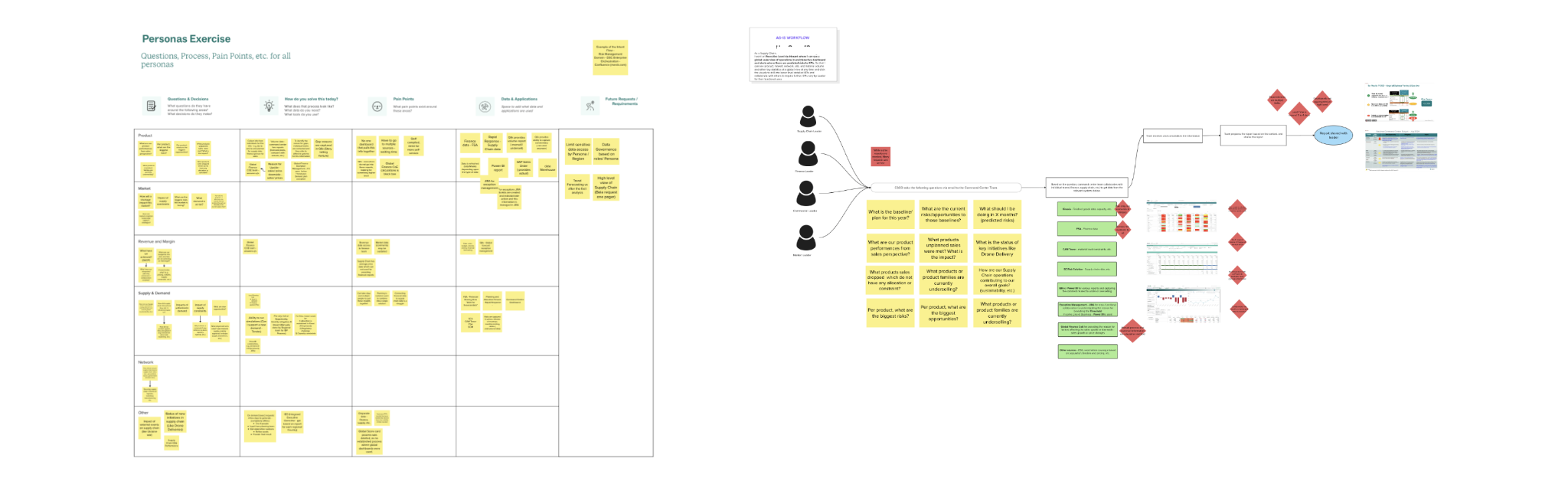
Understanding the needs of accounts payable analysts and suppliers is essential to improving dispute resolution. This section explores user responsibilities, research objectives, workflow challenges and the usability issues that informed the design direction.
Define the primary roles involved in dispute resolution and the responsibilities that shape their day-to-day workflows.
Invoice VerificationReview and validate invoices against purchase orders to ensure accuracy.
Discrepancy IdentificationDetect mismatches such as incorrect amounts, duplicates or missing invoice details.
Dispute AssessmentEvaluate supplier disputes and validate supporting data before escalation.
Collaboration & ResolutionCollaborate with suppliers and internal teams to resolve disputes efficiently.
Approval & ProcessingMake informed decisions to approve or reject claims based on policy and data validation.
Tracking & ReportingMonitor dispute statuses and financial impact to support prioritisation and reporting.
Invoice SubmissionSend invoices for payment processing.
Dispute InitiationRaise disputes for incorrect payments, deductions or missing invoices.
Proof of Payment Document & Evidence UploadProvide supporting documents to validate claims.
Status TrackingTrack disputes, discrepancies and payment adjustments.
Communication with AP AnalystsRespond to requests for additional information or clarification and raise support tickets when disputes cannot be resolved.

Senior Accounts Payable Analyst
Paula is a seasoned AP analyst responsible for managing high volumes of vendor invoices and resolving disputes efficiently. Her day-to-day activities revolve around ensuring accuracy in payments and maintaining smooth financial operations. She values structure, speed and clarity, and often switches between different systems to trace discrepancies or track resolution statuses.
The research plan brings together discovery workshops, in-depth interviews, competitor analysis and synthesis to understand workflow challenges, uncover user needs and inform design decisions.
The research aims to identify inefficiencies, align solutions with business goals and investigate opportunities for measurable improvement. By examining data overload, manual workflows and visibility gaps, the research seeks to gather targeted insights from AP analysts and suppliers. These objectives guide research activities and help translate findings into design opportunities.
Understand how AP analysts and suppliers interact with the dispute resolution process to identify friction points.
Pinpoint key workflow bottlenecks in dispute tracking, vendor communication and payment processing that contribute to delays and financial inconsistencies.
Identify areas where automation and system-driven guidance can reduce manual tasks, improve data accuracy and accelerate resolution.
Evaluate user expectations for an ideal dispute resolution experience, including transparency, real-time updates and effective communication.
Improve end-to-end visibility for faster and more accurate dispute resolution.
Optimise data utilisation and report handling by enabling seamless access to relevant, role-based insights and reducing redundancies.
The design audit served as a critical turning point in understanding and enhancing the user experience of the Supplier Collaboration Portal. Through a comprehensive heuristic evaluation, the process uncovered usability issues that had previously been overlooked or underestimated.
| Usability issue | Description | Tasks affected |
|---|---|---|
| 01. Poor Information Hierarchy |
|
|
| 02. Date Picker & Calendar UX |
|
|
| 03. Visual Cues & Feedback |
|
|
| 04. Consistency & Standards |
|
|
| 05. Accessibility & Visual Hygiene |
|
|
| 06. Data Representation |
|
|
| 07. Customisation & Flexibility |
|
|
| 08. Backend & Logic Bugs |
|
|
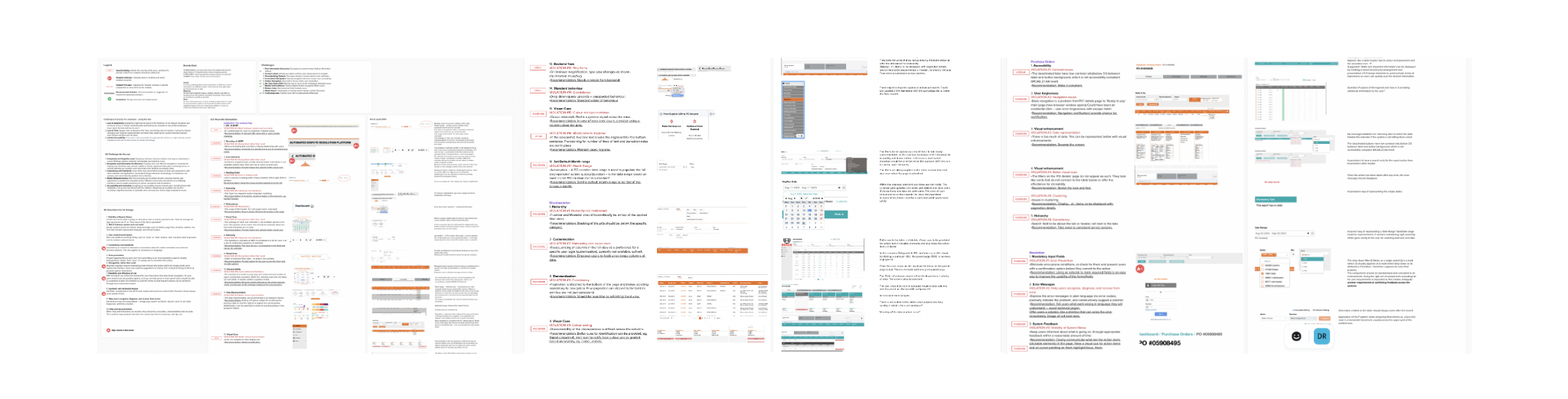
Ultimately, the audit translated abstract usability concerns into concrete, actionable insights—laying the groundwork for a platform that supports intuitive workflows, accessibility and meaningful user engagement.
The primary objective of the in-depth research was to analyse inefficiencies in the current AP Dispute Resolution process and identify opportunities for optimisation.
To assess how users interact with the dispute resolution portal.
To evaluate pain points in tracking disputes and communication with vendors.
To determine workflow bottlenecks causing delays and financial inconsistencies.
To analyse expectations for an ideal dispute resolution system from both user groups.
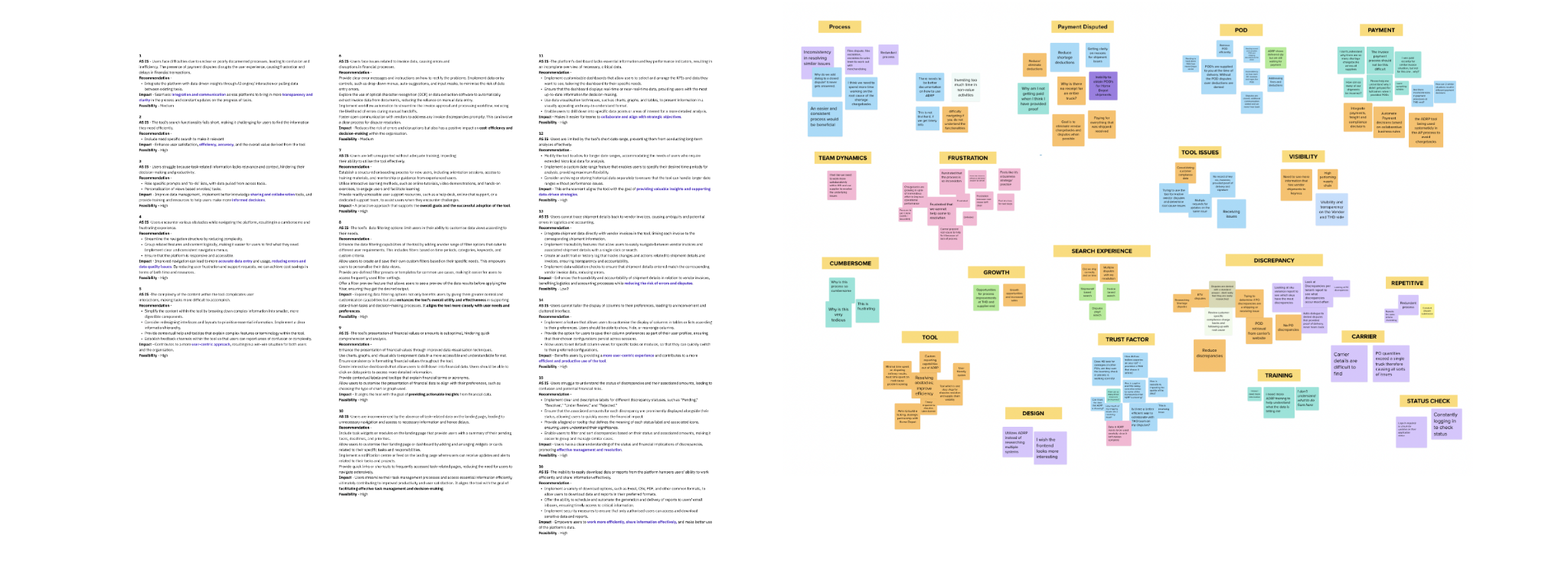
This method helped identify pain points at every interaction within the platform and assess how the existing experience aligned with user needs and expectations.
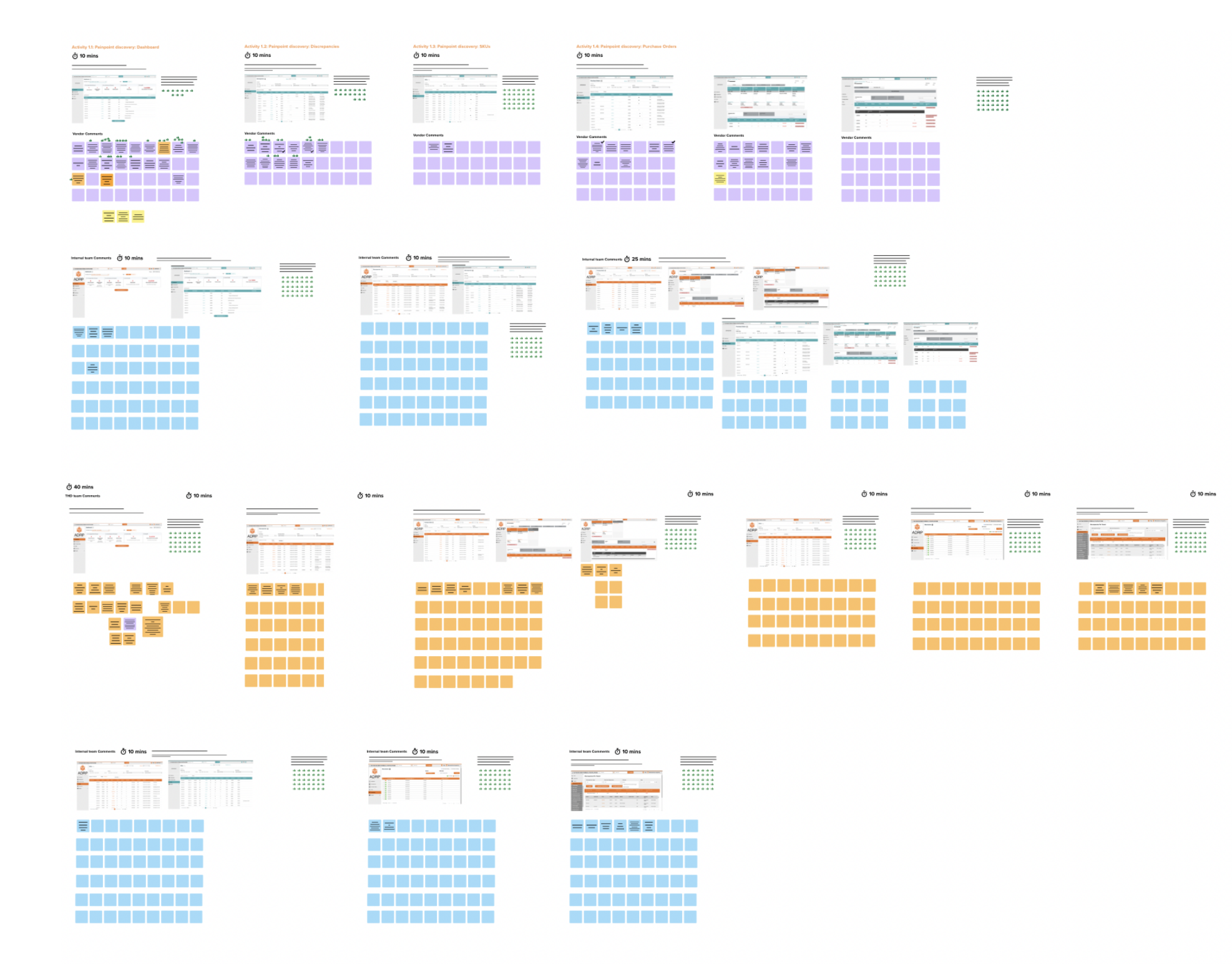
Prioritisation translated the research and audit findings into a clearer order of design attention, helping distinguish critical usability issues from broader opportunities for improvement.
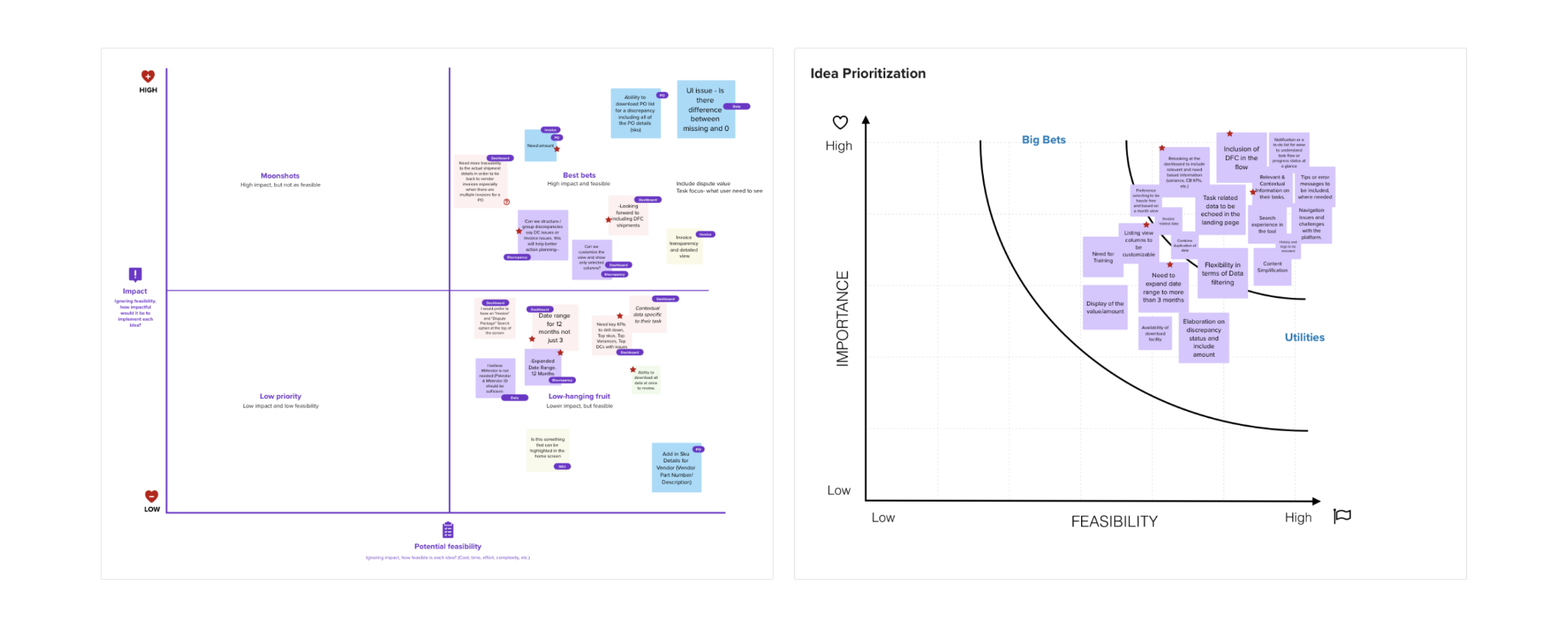
The primary objective of the in-depth research was to analyze inefficiencies in the current AP Dispute Resolution process and identify opportunities for optimization.
CONDENSED RESEARCH SYNOPSIS
A summary of the research coverage, key user needs and the design direction informed by the findings.
Users preferred actionable, role-relevant information over generic KPI-led dashboards.
Users preferred workflows organized around purchase orders, invoices, shortages and disputes.
Important context was sometimes difficult to reach, while missing information and excessive navigation created friction.
Feedback highlighted the need for configurable views, extended date ranges, better discrepancy context and simpler navigation.
Prioritize discrepancies, purchase orders, disputes and invoices over KPI-first navigation.
Improve content hierarchy and reduce the effort needed to reach critical screens.
Support role-relevant landing pages, filters and customizable data views.
Make discrepancy details, progress, insights and notifications easier to access.
The research informed five high-impact redesign areas and established a task-first design direction grounded in user workflows and mental models.
DETAILED RESEARCH SYNOPSIS
The following findings preserve the original research synthesis and show how the evidence informed the redesign direction.
Reorganize entry points based on users goals:
05 / BIG IDEAS
Engineered for seamless navigation, facilitating intelligent decision-making and recommendations to forge a powerhouse supplier ecosystem
01
02
03
04
05
06 / TENETS OF EVOLUTION
These key tenets of evolution represent a dedicated effort to enhance the user experience within the Supplier Collaboration platform. Drawing on insights from collaborative workshops and user research, the vision is to develop a more agile and dynamic platform that addresses diverse user needs.
TENET 01
Facilitate a guided journey that adapts to experienced users’ and new users’ unique needs and preferences, leading to transparency of the data.
TENET 02
Intelligently blend user and system guidance, allowing proactive anticipation and initiation of actions.
TENET 03
Transform rich data into meaningful insights for users by delivering the right data in the right format at the right moment.
The goal is to empower users with efficient access to information, facilitate a guided journey that adapts to both experienced and new users’ unique preferences, and promote transparency of data. This initiative represents a shift from a purely user-directed approach to a system-driven one, intelligently blending user and system guidance for proactive anticipation and initiation of actions.
Empower modern employees with easy access to knowledge, tools, and data on any device through a central platform, enhancing their ability to find information and increase productivity via the ADRP platform.
Customized experiences boost employee engagement and efficiency by aligning content with user interests and allowing personalization through preferences.
Simplification involves reducing cognitive load, organizing content logically, and maintaining consistency in UI patterns. This can be accomplished through simplified search and navigation workflows, communication and enhanced content discoverability.
Embrace continuous improvement and adaptation in design to ensure its ongoing relevance and effectiveness.